
Exgene™ Blood SV DNA Purification Kit (GeneAll)
Exgene™ Blood SV DNA Purification Kit (GeneAll): Reliable Genomic DNA Extraction from Blood, Body Fluids, Cells, and Viral Samples
Introduction
Almost every molecular biology workflow starts with the same step: getting clean DNA out of a biological sample. Whether the goal is genotyping, PCR, sequencing, or pathogen detection, the quality of the extracted DNA determines the quality of everything that follows. Blood is one of the most common starting materials, but it is also a demanding one, because it contains proteins, heme, and other compounds that can inhibit downstream reactions.
The Exgene™ Blood SV kit from GeneAll Biotechnology is a DNA purification kit designed for this task. Its handbook lists three formats, Blood SV mini, Blood SV midi, and Blood SV maxi, so laboratories can choose the scale that fits their samples. This article covers what the kit is, what is in the box, which samples it accepts, and how to use and store it.
What Is the Exgene™ Blood SV Kit?
Exgene™ Blood SV is a silica-membrane spin-column kit for purifying genomic DNA. The “SV” designation refers to this spin-column format. The typical principle is:
- Lysis: the sample is broken down with a lysis buffer and proteinase K, which releases DNA and digests proteins.
- Binding: under suitable salt and ethanol conditions, DNA binds to the silica membrane in the column.
- Washing: wash buffers remove proteins, salts, and other contaminants.
- Elution: pure DNA is released from the membrane in a small volume of low-salt buffer or water.
This approach avoids toxic organic solvents such as phenol and chloroform, and it can be completed in a short time with a standard benchtop centrifuge. For the exact steps and volumes, follow the kit handbook.
What Is in the Box?
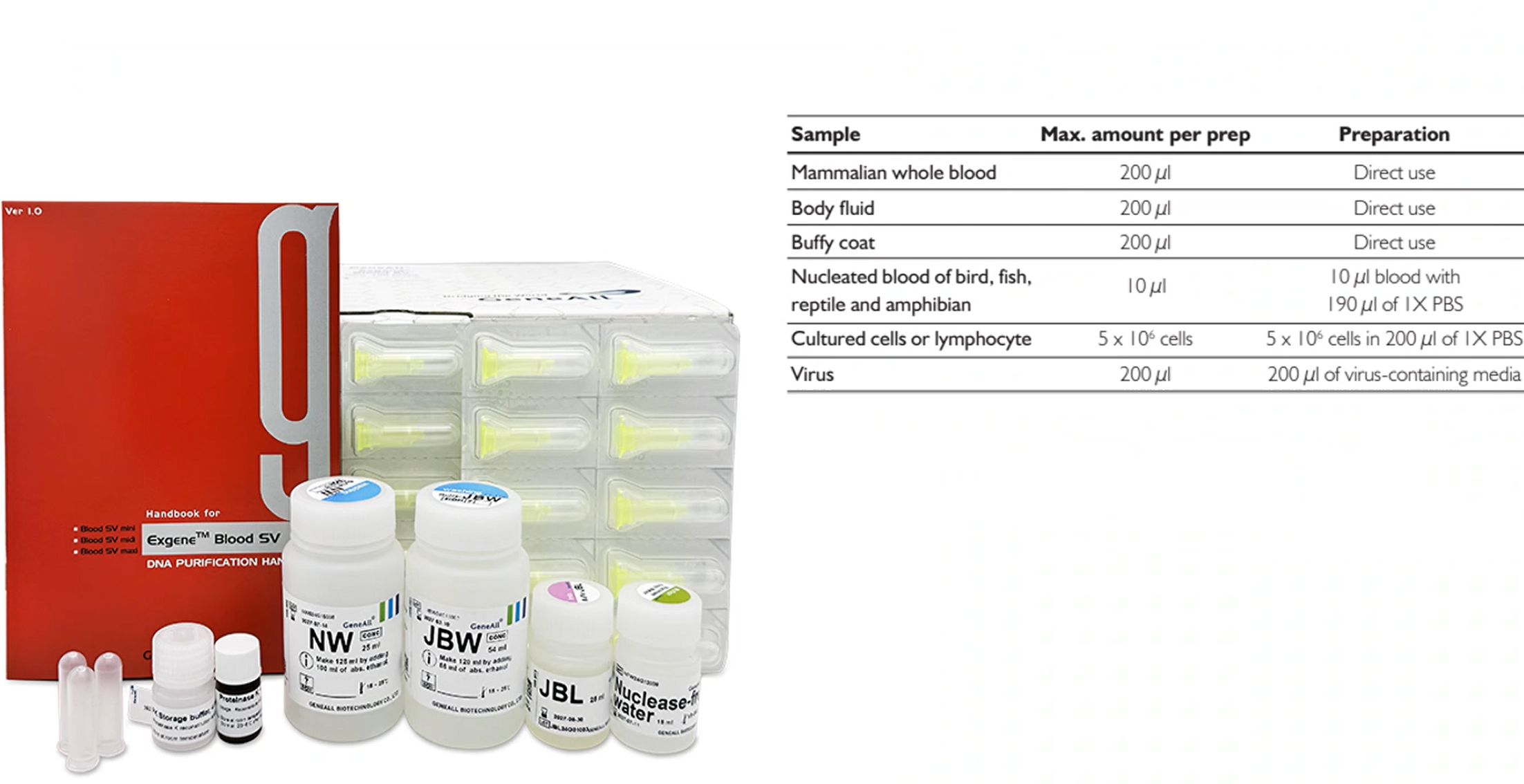
The product image shows the handbook, the spin columns in blister packs, collection tubes, and a set of labeled reagent bottles:
| Component | Notes from the image |
|---|---|
| Handbook | “Handbook for Exgene™ Blood SV,” DNA purification handbook, Ver. 1.0 |
| Spin columns | Packed in protective blister trays |
| Collection tubes | Small clear tubes |
| NW (concentrate) | 25 mL; add absolute ethanol to make 125 mL (per the label) |
| JBW (concentrate) | 54 mL; add absolute ethanol to make 120 mL (per the label) |
| JBL | 25 mL lysis/binding buffer |
| Proteinase K | Small dark vial, supplied with a storage buffer |
| Storage buffer | For reconstituting or storing proteinase K |
| Nuclease-free water | 15 mL, for elution or dilution |
The wash buffers NW and JBW are supplied as concentrates. Before first use, the user adds absolute ethanol as indicated on each label. This keeps the kit compact and extends reagent stability. Remember to tick the label or note the date once the ethanol has been added.
Compatible Samples
The table accompanying the product shows the sample types the kit accepts, the maximum amount per preparation, and any pretreatment needed:
| Sample | Max. amount per prep | Preparation |
|---|---|---|
| Mammalian whole blood | 200 µL | Direct use |
| Body fluid | 200 µL | Direct use |
| Buffy coat | 200 µL | Direct use |
| Nucleated blood of bird, fish, reptile, and amphibian | 10 µL | 10 µL blood with 190 µL of 1X PBS |
| Cultured cells or lymphocytes | 5 × 10⁶ cells | 5 × 10⁶ cells in 200 µL of 1X PBS |
| Virus | 200 µL | 200 µL of virus-containing media |
A few points stand out:
- Direct use for mammalian whole blood, body fluids, and buffy coat means no extra pretreatment is needed before lysis.
- Nucleated blood from birds, fish, reptiles, and amphibians contains far more DNA per volume than mammalian blood, because the red blood cells of these animals have nuclei. That is why only 10 µL is used, diluted in 190 µL of PBS.
- Cultured cells and lymphocytes should be suspended in PBS before processing.
- Viral samples can be processed from virus-containing media, which extends the kit’s use beyond cellular DNA.
This breadth makes the kit useful for human and veterinary laboratories, wildlife and aquaculture research, and virology work.
Key Advantages
1. Versatile sample range. One kit handles mammalian blood, body fluids, buffy coat, non-mammalian nucleated blood, cultured cells, and virus-containing media.
2. Scalable formats. The handbook covers mini, midi, and maxi versions, so the same chemistry serves small and large sample volumes.
3. Spin-column convenience. Standard centrifugation, no phenol or chloroform, and a straightforward workflow.
4. Concentrated wash buffers. Less bulk to store and ship; you add ethanol when ready.
5. Complete kit. Columns, tubes, buffers, proteinase K, and nuclease-free water are included.
6. Documentation. A handbook accompanies the kit, with the procedure and the sample table.
Applications
Genotyping and PCR
DNA purified from blood is used for SNP genotyping, PCR, and qPCR, including diagnostic and population studies.
Sequencing and Library Preparation
Clean genomic DNA is the starting material for many sequencing workflows. Always check that the yield and quality fit your library method.
Veterinary and Wildlife Research
The ability to process nucleated blood from birds, fish, reptiles, and amphibians supports species identification, sexing, population genetics, and conservation studies.
Cell Culture and Biobanking
Cultured cells and lymphocytes can be processed for cell line authentication, genetic stability checks, and archival of DNA samples.
Virology
Virus-containing media can be processed for viral nucleic acid extraction, for instance as a first step in detection or characterization workflows. Confirm in the handbook that the kit’s chemistry fits your target virus type.
Clinical and Epidemiological Research
Blood and body fluid samples are processed in studies that need consistent DNA extraction across many specimens.
General Workflow
The exact protocol is in the handbook. In general:
- Prepare the reagents: add absolute ethanol to NW and JBW, and reconstitute proteinase K as directed.
- Prepare the sample according to the table above.
- Lyse the sample with proteinase K and the lysis buffer, then incubate.
- Adjust binding conditions and transfer the lysate to a spin column.
- Centrifuge so that DNA binds to the membrane.
- Wash with the prepared wash buffers.
- Dry the membrane to remove residual ethanol.
- Elute the DNA with nuclease-free water or elution buffer.
- Quantify and check quality by spectrophotometry or fluorometry, and by gel electrophoresis if needed.
Storage and Handling
- Store the buffers at room temperature, as shown on the bottle labels (about 15–25 °C).
- Store proteinase K as stated on its label and in the handbook. Enzyme components often need cooler storage after reconstitution.
- Add ethanol to NW and JBW before first use, and keep the bottles tightly closed to avoid evaporation.
- Do not mix lysis buffers with bleach, since guanidine-containing solutions can release hazardous compounds with oxidizers.
- Handle blood and body fluids as potentially infectious and follow your institution’s biosafety rules.
- Wear gloves, a lab coat, and eye protection, and dispose of waste according to local regulations.
- Record lot numbers for traceability.
About GeneAll Biotechnology
GeneAll Biotechnology is a manufacturer of nucleic acid purification kits and related molecular biology products. The branding on the packaging, “GeneAll,” appears on the bottle labels and box. Its Exgene™ line is focused on genomic DNA extraction from a range of sample types.
Frequently Asked Questions
What sample types can I use?
Mammalian whole blood, body fluids, buffy coat, nucleated blood from birds, fish, reptiles, and amphibians, cultured cells or lymphocytes, and virus-containing media.
How much blood can I process per prep?
Up to 200 µL of mammalian whole blood in the standard format. For nucleated blood of birds, fish, reptiles, and amphibians, use 10 µL diluted in 190 µL of 1X PBS.
How many cells can I use?
Up to 5 × 10⁶ cultured cells or lymphocytes, suspended in 200 µL of 1X PBS.
Do I need to add ethanol?
Yes, to the NW and JBW concentrates before first use, as stated on their labels.
Are there different kit sizes?
The handbook lists mini, midi, and maxi versions.
Does it use phenol or chloroform?
No, it is a silica-membrane spin-column method.
Conclusion
The Exgene™ Blood SV kit from GeneAll offers a practical, versatile way to purify genomic DNA from blood and other biological samples. With a broad sample table, concentrated wash buffers, scalable formats, and a complete set of reagents and consumables, it fits genotyping, veterinary, cell biology, and virology workflows alike.